The Oud: King of Arabic Musical Instruments
Explore the history of the oud and its importance in Arabic music, from its ancient origins to the present day

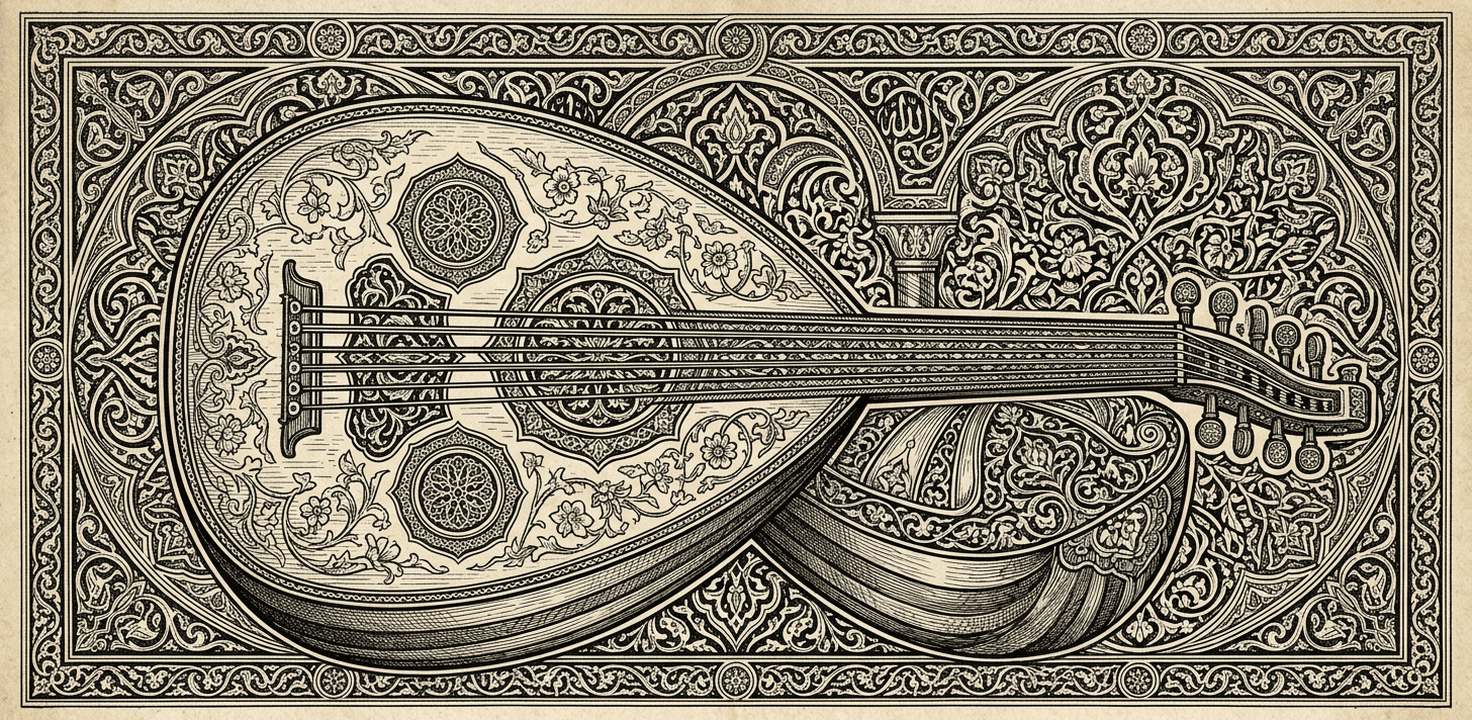
The Oud: King of Arabic Musical Instruments
The oud is known as the "king of instruments" in the Arab world—a stringed instrument with a deep, captivating sound that has enchanted hearts for thousands of years. The oud is distinguished by its pear-shaped body and short, fretless neck, making it the perfect tool for playing Arabic maqamat and the subtle details of quarter-tone melodies.
Origin of the Name and History
It is believed that the word "oud" is derived from the Arabic word meaning "wood," due to the construction of the back body from thin wooden strips. Some researchers suggest that the oud evolved from the ancient Persian "barbat" instrument, which appeared in the 1st century BC.
The earliest evidence of the oud's ancestors dates back to Mesopotamia (modern-day Iraq) more than 5,000 years ago, where engravings and statues show musicians playing instruments resembling the oud from the Uruk period (around 3100 BC).
Structure and Design
The traditional oud consists of:
- The Body: A pear shape built from 15-25 thin wooden strips joined together to form the curved back
- The Neck: Short and fretless, allowing for extremely precise playing and navigation between quarter tones
- Sound Holes: Usually 1-3 oval or circular, carefully decorated openings
- Strings: 11 strings typically, distributed across 5 courses (pairs) and one single bass string
- Pegbox: Angled backward at 45-90 degrees from the neck
Types of Oud
The Arabic Oud
Larger in size with a deeper, warmer tone. The scale length ranges between 61-62 cm. Widely used in Egypt, Iraq, the Levant, and the Maghreb.
The Turkish Oud
Smaller and tuned a whole step higher than the Arabic oud. Characterized by a brighter, clearer sound. The scale length is approximately 58.5 cm.
The Egyptian Oud
Famous for its richly decorated design and vibrant colors on the fingerboard. Characterized by a warm, rich sound full of overtones.
The Iraqi Oud
Known for its precise playing techniques and pure tones. The Iraqi school of oud playing is renowned for its unique traditional style.
The Importance of Oud in Arabic Music
The oud is considered the backbone of Arabic music for several reasons:
- Performance Versatility: Can be played in diverse styles from traditional to modern
- Maqam Adaptation: The fretless oud allows for precise playing of all Arabic maqamat, including quarter tones
- Taqsim: Widely used in improvisational taqasim that showcase the player's skill
- Historical Roots: Dating back thousands of years, making it an integral part of Arab musical identity
Famous Oud Players
Ziryab (789-857 CE)
Credited with adding the fifth string to the oud and considered the founder of the first music school in Andalusia. Played a major role in spreading the oud to Andalusia and then to Europe.
Munir Bashir (1930-1997)
An Iraqi musician considered one of the greatest oud players of the 20th century. Developed new techniques in playing and expanded the instrument's capabilities.
Naseer Shamma (b. 1963)
A contemporary Iraqi player known for his delicate, emotional style. Founded the Arab Oud House in Cairo to teach oud playing.
Mohamed El Qasabgi (1895-1966)
One of Egypt's most famous oud players, performed with Umm Kulthum, Mohamed Abdel Wahab, and other giants of Arabic song.
Oud and Luthiery
Oud making is considered a refined art requiring high skill and deep knowledge of woods. Among the most famous oud makers:
- Mohammed Fadel (Iraq): Considered one of the most prominent oud makers in Iraq, made the first oud for Munir Bashir in 1956.
- Faruk Turunz (Turkey): Considered one of the best oud makers in the world, uses the "double soundboard" system in his craft.
Types of Wood Used
- Oud Back: Usually made of walnut, maple, rosewood, or mahogany
- Oud Face: Cedar wood is used for Arabic ouds and spruce for Turkish ouds
- Fingerboard: Usually walnut or ebony
Oud and World Music
The oud played a pivotal role in the development of stringed instruments in Europe. When the oud moved to Andalusia with the Islamic conquest, it evolved into the European "lute," which later had frets added. The lute is considered a direct ancestor of the modern guitar.
In modern times, the oud has become popular in world music, jazz, and fusion, where musicians from different cultures use it in innovative musical projects.
How to Start Learning Oud?
- Choose the Right Oud: For beginners, the smaller Turkish oud is recommended as it's easier to handle
- Learn Maqam Basics: Start with basic maqamat like Rast, Bayati, and Ajam
- Daily Practice: Even 30 minutes a day is enough to progress
- Listen Extensively: Listen to recordings of great oud players to understand different styles
- Find a Teacher: Lessons with a skilled teacher accelerate learning significantly
Conclusion
The oud remains a symbol of authentic Arabic music and a bridge connecting past and present. With its deep, emotional sound, the oud continues to inspire both musicians and listeners alike, preserving a rich musical heritage that spans thousands of years.
Want to learn the oud? Start your musical journey today with the Noota app, where you'll find interactive lessons to learn the oud and other instruments!